
Trade deal hopes, chip rally lift Seoul market
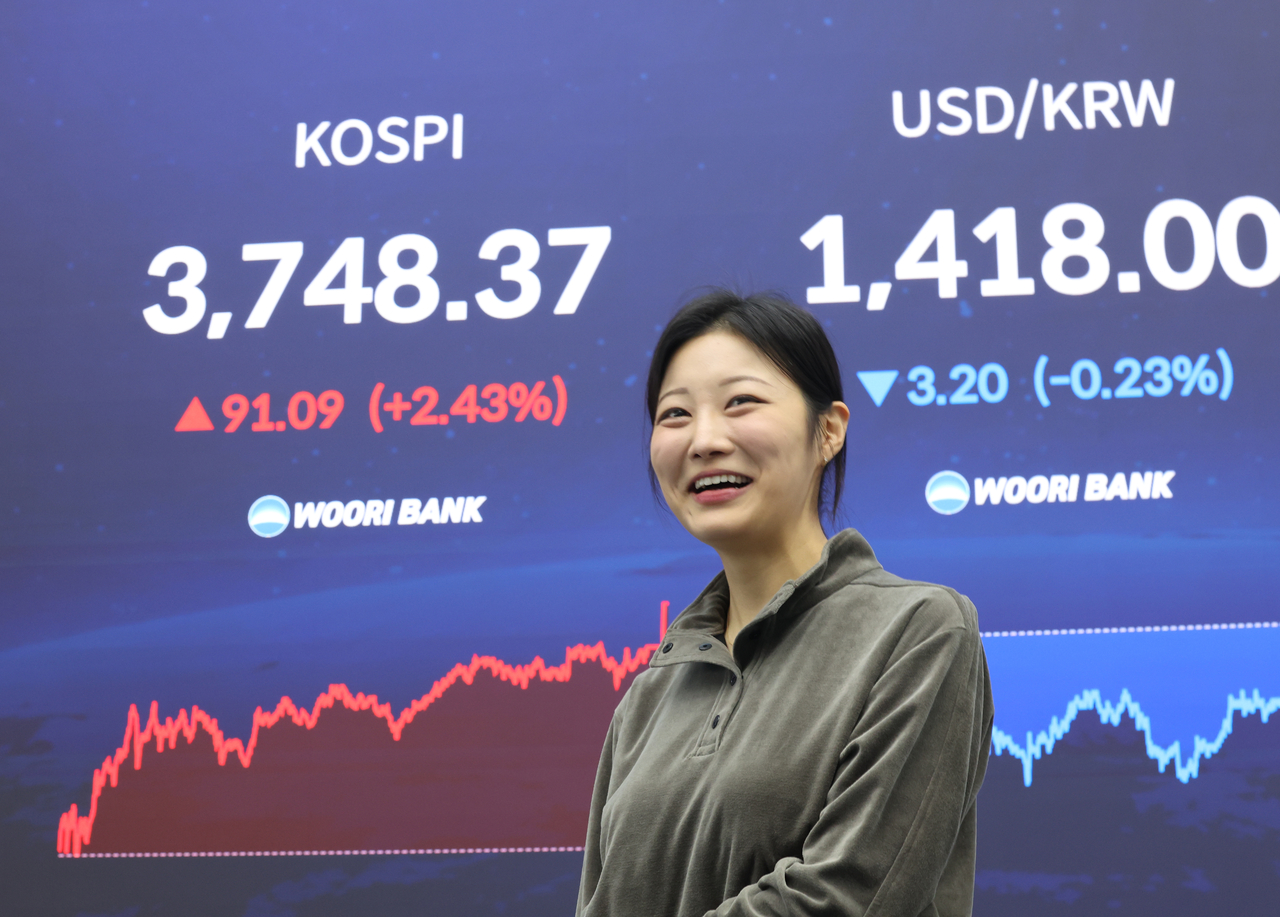
Kospi reached a historic high on Thursday, breaking past 3,700 points for the first time, buoyed by strong earnings and optimism that Seoul and Washington are nearing a deal in their trade negotiations.
Seoul’s benchmark index closed at a record 3,748.37, up 91.09 points, or 2.49 percent. It opened 0.51 percent higher at 3,675.82, immediately surpassing the previous intraday record of 3,659.91 set a day earlier. The index crossed 3,700 within 15 minutes of trading and continued to climb through the session. Momentum strengthened in the afternoon, pushing the Kospi beyond 3,730 at around 1:10 p.m., before closing at its highest level ever.
Kospi’s total market capitalization had edged up to 3,086 trillion won ($2.17 trillion) as of Thursday’s close, after surpassing 3,000 trillion won for the first time the previous day.
Foreign investors, who initially drove the rally, were overtaken late in the session by institutions. Foreigners ended as net buyers of 653 billion won in Kospi stocks, while institutions purchased a net 742 billion won. Retail investors offloaded about 1.4 trillion won to lock in gains.
Sentiment strengthened after signals from both governments pointed to progress in resolving differences over Seoul’s pledge to invest $350 billion in the US. US Treasury Secretary Scott Bessent told CNBC on Wednesday that “we are about to finish up with Korea,” and said separately in a press briefing he expects “something” in the next 10 days. Korea’s presidential chief of staff for policy, Kim Yong-beom, also expressed optimism before departing for Washington on Thursday.
The prospect of a breakthrough sparked a rally in auto shares in particular in Seoul, among the sectors most affected by trade uncertainty. Hyundai Motor jumped nearly 8.3 percent and Kia advanced 7.2 percent.
“Automobile companies will be one of the biggest beneficiaries once the trade negotiations wrap up successfully, and their stocks remain clearly undervalued,” said Lee Jae-won, an analyst at Shinhan Securities. “We can expect further rebounds in large export stocks, such as autos, which will serve as an upward driver for the Kospi.”
Semiconductor blue chips also powered the advance, with Samsung Electronics and SK hynix both setting fresh records amid renewed global optimism over artificial intelligence demand and solid earnings.
Samsung climbed to 97,700 won, its highest level since January 2021, and closed at that price. SK hynix surged as much as 7.7 percent to an all-time high of 455,000 won before paring some gains. As of Thursday’s close, the two chipmakers together accounted for roughly 30 percent of the Kospi’s total market capitalization, with a combined value of about 900 trillion won.
Other major gainers included LG Energy Solution, which jumped 8.8 percent, and Samsung C&T, up 5.3 percent, while biopharmaceutical firms such as Samsung Biologics and Celltrion also posted modest gains.
Kim Dae-jun, an analyst at Korea Investment & Securities, said the Kospi could gain further, potentially reaching 3,750 in the coming month if the currency remains stable.
“Verbal intervention by local foreign exchange authorities and the monetary easing stance have created room to slow the pace of the won’s depreciation,” he said. “Unless the won weakens beyond 1,500 per dollar, the current bullish market mood is unlikely to reverse.”
The won strengthened slightly Thursday, trading around 1,419 per US dollar compared with 1,421 at the start of the day. The currency has been under pressure in recent weeks, staying above the 1,400 level since Sept. 24 and briefly touching 1,430 earlier this week, prompting verbal intervention by local authorities.
Meanwhile, the tech-heavy Kosdaq ended nearly flat, inching up 0.08 percent to 865.41. Individual investors were net buyers of 350 billion won, while foreigners and institutions offloaded a combined 330 billion won.
By Choi Ji-won (jwc@heraldcorp.com)