

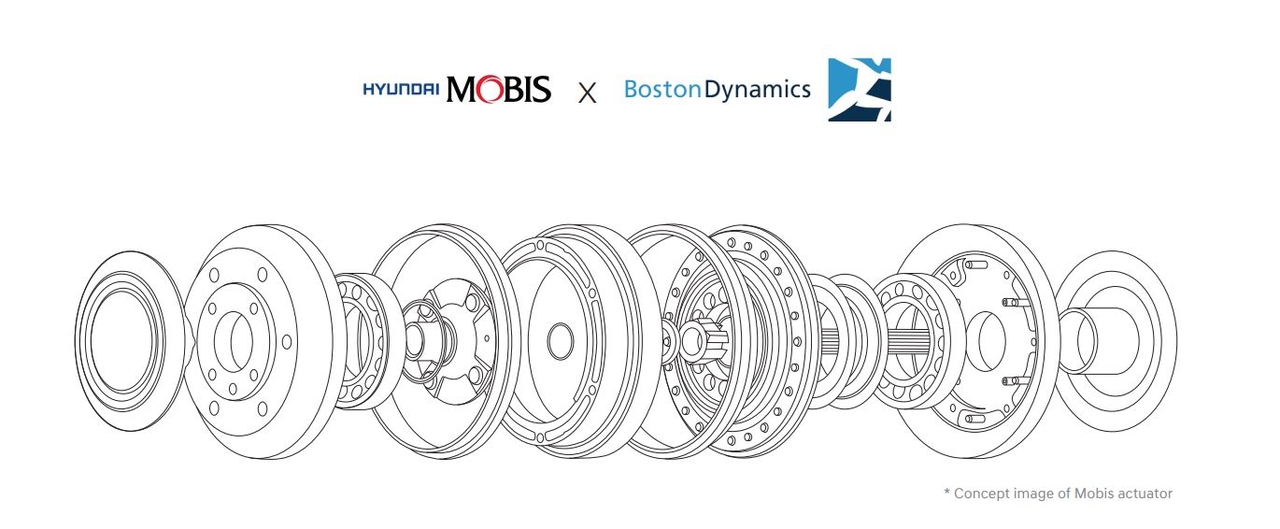
LAS VEGAS — Hyundai Mobis on Tuesday said it will supply key components for Boston Dynamics’ next-generation Atlas humanoid robot, marking its first commercial customer in the robotics components business as the auto parts maker accelerates its push beyond traditional automotive parts.
Under the plan unveiled at CES 2026, Hyundai Mobis will provide actuators for Atlas — the humanoid robot developed by Boston Dynamics, Hyundai Motor Group’s US-based robotics unit — when the model enters mass production. Actuators, which convert control signals into physical movement, account for about 60 percent of the material cost of humanoid robots, according to the company.
Hyundai Mobis said it plans to build a mass-production system for actuators and gradually expand its robotics portfolio to include hand grippers, sensors, controllers and battery packs.
The move aligns with Hyundai Motor Group’s broader push into robotics manufacturing. In August 2025, the group announced plans to build a robot factory in North America with an annual capacity of 30,000 units. Hyundai Mobis said it will support the group’s robot production strategy while expanding its business beyond automotive components.
Separately, Hyundai Mobis also announced a strategic partnership with Qualcomm to jointly develop solutions for software-defined vehicles (SDV) and advanced driver assistance systems.
Under the agreement, the two companies will develop integrated solutions optimized for emerging markets such as India, where demand for driver assistance features is rising as vehicle lineups expand beyond small cars. The offerings will combine Qualcomm’s automotive chips with Hyundai Mobis’ controllers and software, incorporating technologies such as sensor fusion, image recognition and system-on-chip integration.
Hyundai Mobis said it is also developing a broader SDV solution aimed at improving vehicle performance, efficiency, stability and scalability. The company added that it is already working with Qualcomm on vehicle-to-everything technologies, including systems that detect obstacles beyond a driver’s line of sight and automatically trigger emergency braking.
By Ha Neul-bit (andreahaneu@heraldcorp.com)