
Retail, foreign investors tip board vote despite stake disadvantage
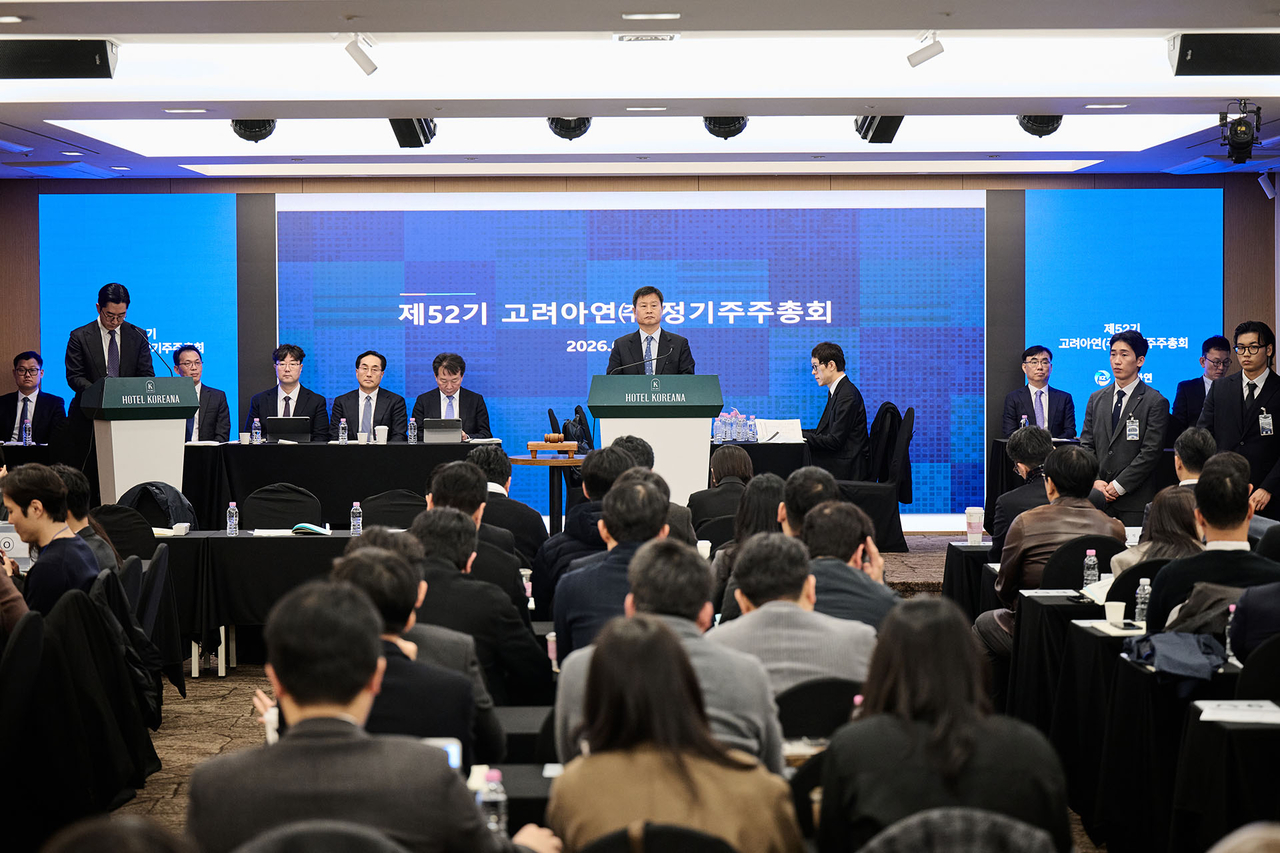
Broader investor support, led by retail and foreign investors, was behind the victory of incumbent leadership at Korea Zinc’s annual general meeting, ultimately swinging the outcome in Chair Choi Yun-beom’s favor in one of the most closely watched boardroom battles in South Korea.
Tuesday’s shareholders meeting came amid a prolonged proxy fight between Choi and a consortium led by private equity firm MBK Partners and Young Poong, which launched a tender offer to seek greater control over Korea Zinc’s management in late 2024.
The Young Poong-MBK faction holds roughly 41.1 percent, while Choi and his allies hold 37.9 percent.
The key battleground at Tuesday’s meeting was how many board seats each side would secure, and whether Choi would be reappointed to the board.
First on the agenda was determining the number of directors to fill six vacant seats. Management’s proposal to select five directors prevailed over the opposing bloc’s plan to nominate six. Choi’s proposal secured 62.98 percent of the vote, compared to 52.21 percent for the MBK-Young Poong side.
The roughly 10.8 percentage-point gap suggests minority shareholders — estimated to hold about 15 percent of Korea Zinc — largely sided with current management, according to industry officials.
Among the five newly appointed directors, two from Choi’s camp — including Choi himself and board Chair Hwang Deok-nam — secured reappointment. Meanwhile, MBK-backed nominees Choi Yon-sog, a partner at MBK Partners, and lawyer Lee Sun-sook joined the board. The fifth seat went to Walter Field McLallen, backed by Crucible JV — a joint venture between Korea Zinc and the US government for its planned US smelter — who received the most votes.
A separate proposal to expand the number of audit committee members elected independently from one to two was rejected, leaving one such seat to be filled at a later date.
Following the meeting, the board now consists of 14 members, with nine aligned with Choi — including Crucible’s McLallen — and five representing the MBK-Young Poong alliance.
The outcome defied market expectations that the board split could narrow to as tight as 9-5 or even 8-6, given Choi’s numerical disadvantage in shareholding. It also came despite last-minute decisions by the National Pension Service, which holds a 5.2 percent stake in Korea Zinc, and the California Public Employees’ Retirement System — the largest public pension fund in the US — not to back Choi’s reappointment.
Observers say Choi’s camp was able to gain the upper hand under Korea’s cumulative voting system, which allows shareholders to concentrate their votes on specific candidates by allocating multiple votes per share based on the number of board seats available.
The result also suggests that broader shareholder sentiment — particularly among foreign funds and retail investors — proved decisive in tipping the balance in Choi’s favor, they added.
If the separately elected audit committee member — which must be appointed before revisions to South Korea’s Commercial Act take effect in September — is also filled by a Choi-backed candidate, the gap between the two sides could widen further to 10-5.
This appointment is subject to the “3 percent rule,” which caps the voting rights of controlling shareholders at 3 percent in such cases, effectively amplifying the influence of minority shareholders.
Overall, market officials pointed to investor trust in management’s proven track record and long-term strategy as the key driver behind the outcome. Under Choi’s leadership, Korea Zinc posted record profits last year, buoyed by higher recovery rates of precious metals such as gold, silver and indium, as well as its core smelting operations in zinc, lead and copper.
Investor sentiment was also supported by expectations surrounding the company’s plan to build a critical minerals processing facility in the US, as shareholders appear to be betting on Korea Zinc’s ambition to position itself as a key player in the global critical minerals supply chain.
“The significance of this shareholders meeting's outcome is substantial,” an investment banking official said. “Shareholders are placing greater value on sustainability, competitiveness, earnings performance and long-term growth rather than short-term or one-off measures.”
By Ahn Sung-mi (sahn@heraldcorp.com)