
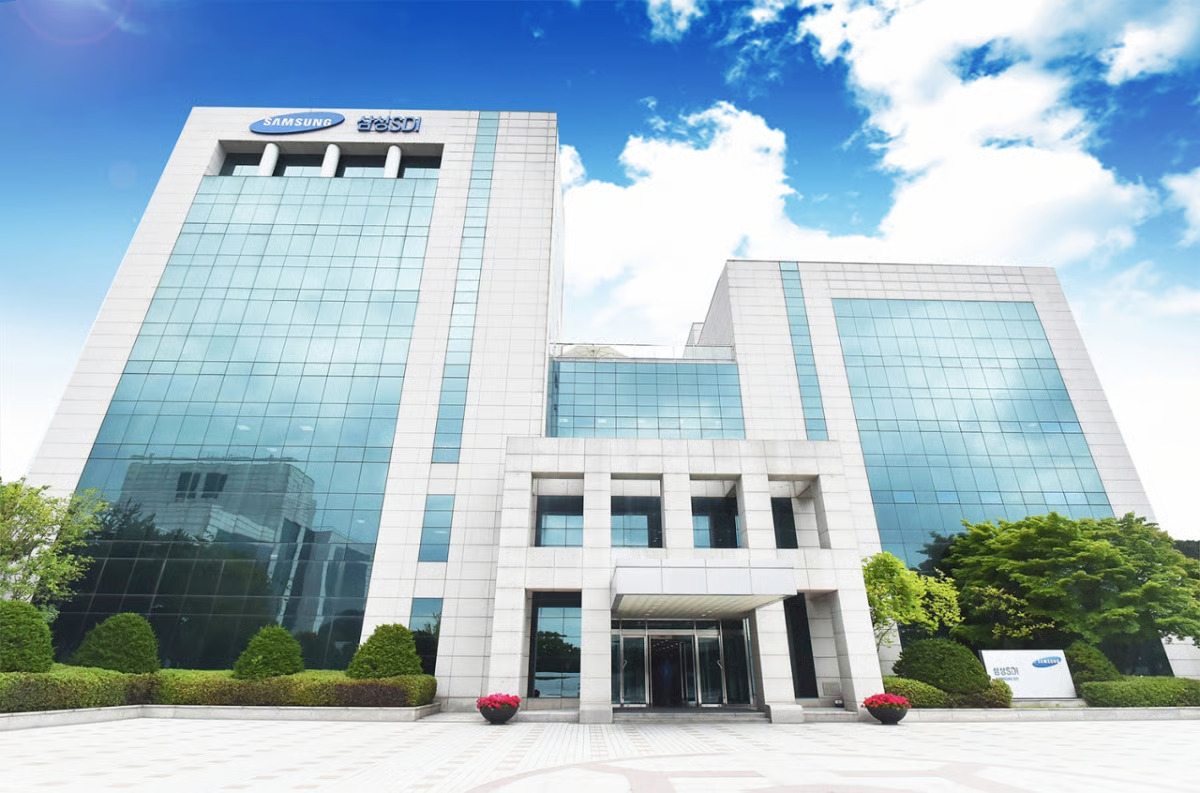
Samsung SDI significantly reduced its operating loss in the first quarter this year, supported by surging demand for energy storage systems driven by the artificial intelligence data center boom.
According to the company’s earnings call Tuesday, its operating loss narrowed 64.2 percent year-on-year to 155.6 billion won ($105.6 million), while revenue rose 12.6 percent to 3.58 trillion won.
Battery sales revenue fell 7 percent from the previous quarter, but increased 13 percent on-year to 3.35 trillion won, reflecting a recovery in demand across utility-scale ESS, AI data centers and power tools.
Operating losses narrowed on both a quarterly and annual basis, supported by higher Advanced Manufacturing Production Credit benefits from expanding US-made ESS sales, as well as shipments of high-margin cylindrical batteries used in battery backup units for data centers and professional-grade power tools — key equipment in AI data center construction.
These high-performance batteries feature a tabless design that eliminates traditional metal tabs connecting electrodes to terminals, improving energy density, power output and charging performance. Samsung SDI plans to begin supplying tabless cells for BBUs in the second quarter and for hybrid electric vehicles in the second half of the year.
Despite ongoing global uncertainties, including tensions in the Middle East, Chief Financial Officer Oh Jae-kyun said the impact on the company has been limited, adding that performance has rebounded since bottoming out in the third quarter of last year. Losses are expected to narrow further in the second quarter, with the company aiming to return to quarterly profit in the second half.
As global demand for electric vehicles gradually recovers — led by major European markets such as Germany and France — Samsung SDI plans to begin battery production for new mass-market EV models. This is expected to lift utilization at its Hungary plant to above 70 percent in the second half of the year.
The company recently signed its first prismatic battery supply deal with Mercedes-Benz, adding to its customer base that includes BMW and Audi.
For its ESS business, Samsung SDI expects US data center demand to grow by more than 30 percent annually, from 9 gigawatt-hours in 2025 to over 40 gigawatt-hours by 2030. It added that a significant portion of its US ESS production capacity is already booked for the next two to three years as it expands partnerships with data center operators, utilities and system integrators.
To support this growth, the company is building a non-China supply chain for lithium iron phosphate battery cathode materials, in line with US “One Big Beautiful Bill Act” rules that cap the share of materials from prohibited foreign entities at 40 percent this year, declining to 15 percent by 2030.
Regarding its plan to sell its entire 15.2 percent stake in Samsung Display — valued at about 10 trillion won — Samsung SDI said it aims to complete the transaction within this year.
By Byun Hye-jin (hyejin2@heraldcorp.com)