
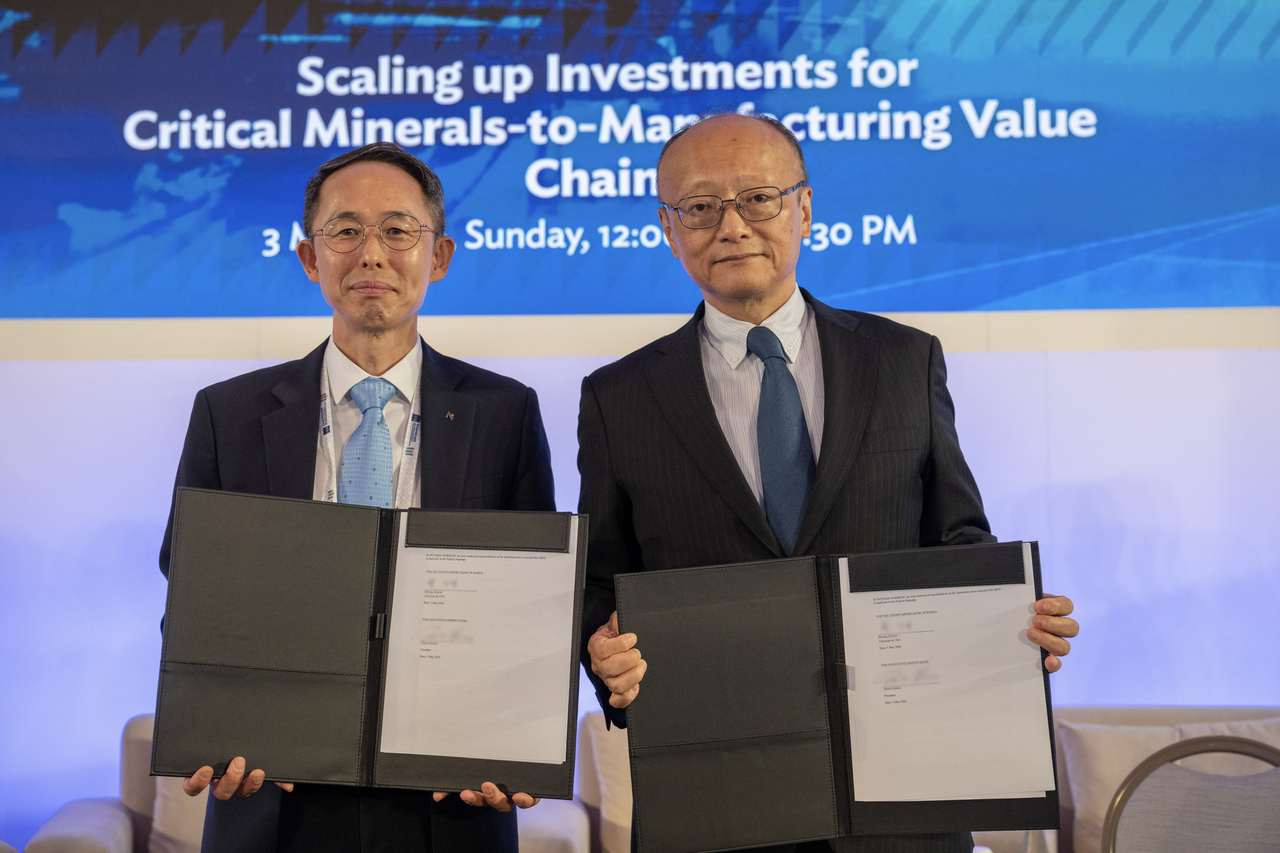
The Export-Import Bank of Korea has signed a memorandum of understanding with the Asian Development Bank to support critical minerals projects and establish a joint financing platform, the bank said Sunday.
Under the agreement, Eximbank will commit $500 million by 2029 through its supply chain stabilization fund to participate in ADB’s newly launched critical minerals-to-manufacturing financing partnership facility, which targets projects across the Asia-Pacific.
Eximbank President and CEO Hwang Ki-yeon and ADB President Masato Kanda signed the deal on the sidelines of the ADB annual meeting in Samarkand, Uzbekistan.
The bank said it will deploy a range of financing tools — including loans, guarantees and equity investments — and plans to expand its total support to between $2 billion and $3 billion over time.
The two institutions will work together to identify promising critical minerals projects in developing economies and provide co-financing across the value chain, from upstream resource development to downstream manufacturing. They also plan to structure financing packages combining loans, guarantees and technical assistance to support higher-risk projects.
Eximbank said it will prioritize projects that help stabilize supply chains, including those in which Korean companies acquire equity stakes or secure long-term off-take agreements for key resources.
“This agreement marks the first policy financing framework aimed at stabilizing supply chains through cooperation with a credible international institution,” Hwang said.
“We will work closely with ADB to support Korean companies’ entry into resource-rich developing markets in the Asia-Pacific that lack commercial infrastructure.”
By Lee Han-gyoul (stlee0329@heraldcorp.com)