
New battery design with LG Energy Solution, chassis innovation drive electric sportiness
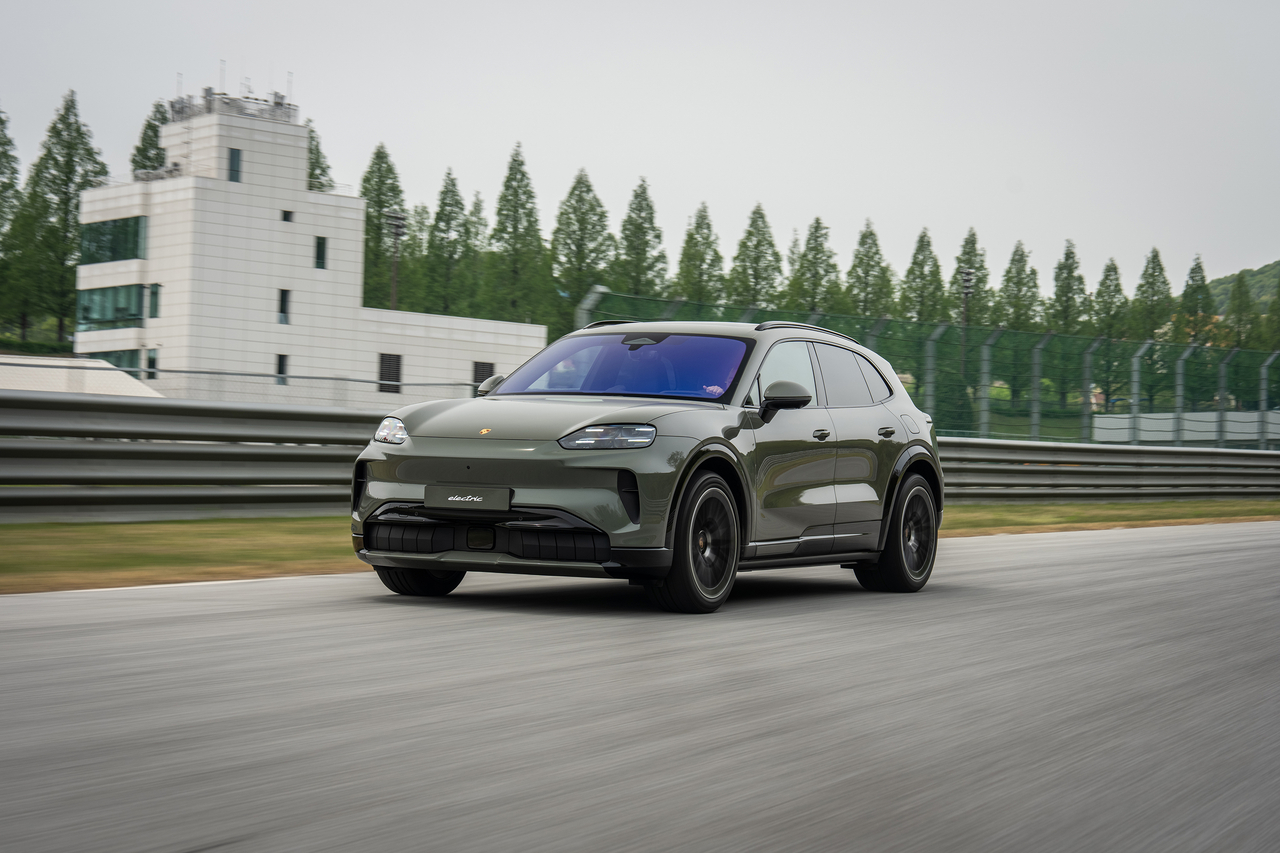
Porsche Cayenne Electric marks Porsche’s most aggressive push yet to extend the flagship SUV’s success in Korea, pairing a new battery architecture with a next-generation platform.
The German luxury automaker is aiming to surpass its 2023 milestone of 10,000 units, betting on a sportscar-like electric SUV that blends performance with everyday usability.
At Porsche’s first Asia-Pacific region media test drive in Yongin, The Korea Herald took part in track sessions and a gymkhana-style handling course to gauge the model’s performance and agility firsthand.
The Cayenne Coupe Electric Turbo — a performance-focused variant with greater power and more advanced hardware than the base model — delivers a smooth yet powerful ride on the track, in Comfort mode.
But when switched to Sport mode, the SUV noticeably sharpens throttle and steering response. That even accelerates with a combination of Sport Plus mode and the Push-to-Pass function. The temporary power boost gives a surge of acceleration as if riding a race car, narrowing the gap to the car ahead in just seconds.
Despite its high-performance capability, Porsche’s Active Ride system — available for the first time for the brand’s SUV model — keeps the vehicle’s body level stable under dynamic driving conditions, effectively minimizing roll and pitch.
In a tight handling course, the Cayenne Electric Turbo’s launch control system enables up to 1,156 PS (Pferdestarke) and propels the SUV from 0 to 100 kilometers per hour in approximately 2.5 seconds, with a maximum speed of 260 kilometers per hour.
The SUV’s rear-axle steering reduces the turning radius and required steering angle, allowing for tighter, more agile maneuvering — not only on the road but also when navigating tight parking spaces in Korea.
Behind the performance of the Cayenne Electric lies a new battery design by Porsche, built around a 113-kilowatt-hour high-voltage battery. Pointing to deep ties with LG Energy Solution, Director of Cayenne Energy System Marco Schmerbeck said the SUV adopts LG’s pouch cells in a modular architecture, with cell stacks integrated directly into reinforced aluminum profiles.
This design enhances durability by channeling crash loads around the cells through a structural safety cage. Instead of a bulky traditional battery pack housing, this space-efficient layout also reduces the car’s overall weight, contributing to driving ranges of up to 642 kilometers and 623 kilometers for the base and turbo models, respectively, on a single charge.
The Cayenne Electric is not all about performance. According to Vivien Schreiber, manager of Cayenne drive system, the vehicle comes with adaptive air suspension and Porsche Active Suspension Management as standard. This allows it to adjust its ride height and maintain a level body across a range of driving conditions and terrain for improved comfort.
Highlighting the strategic importance of the Korean market, Porsche offers a Korea-specific package for the Cayenne Electric, bundling a wide range of features as standard. These include rear-axle steering, heated seats for both front and rear passengers, a heated windscreen, front-seat ventilation and four-zone climate control.
Slated for launch in Korea in the second half of this year, the new Porsche Cayenne Coupe Electric is now available for order. Prices start at 146.9 million won ($99,500) for the base model, 167.2 million won for the S, and 191 million won for the Turbo.

By Byun Hye-jin (hyejin2@heraldcorp.com)