
Why Wall Street paid premium, what record raise will fund and whether Korea will share gains
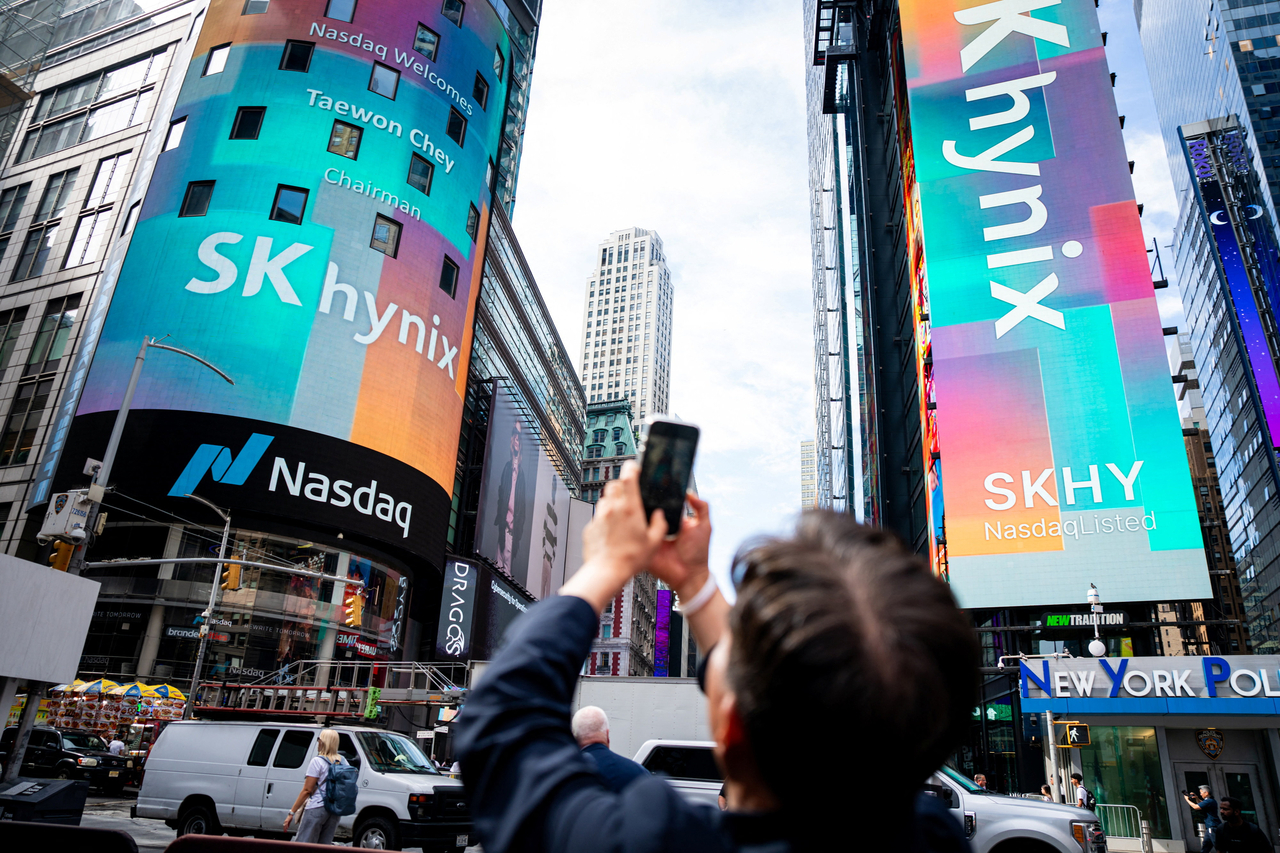
SK hynix’s Nasdaq debut settled one question quickly: US investors wanted direct access to the Korean memory-chip leader.
The chipmaker’s American depositary receipts opened at $170 and closed Friday at $168.01, about 13 percent above the $149 offer price. More than 106 million ADRs changed hands, according to Bloomberg, after the company raised $26.5 billion in the largest US share sale by a foreign company.
SK Group Chairman Chey Tae-won called the Nasdaq debut "a truly historical moment" and "a dream come true," saying it would give SK hynix "a new kind of momentum" by expanding access to global capital markets.
The strong debut showed that investors wanted direct access to the world’s leading supplier of high-bandwidth memory, or HBM. It did not settle the bigger questions for Korea: whether the US premium will spread to the Seoul-listed shares, how long the two prices can remain apart and whether SK hynix can turn the proceeds into profitable capacity.
What changed for investors?
Each SK hynix ADR represents one-tenth of a common share listed in Seoul, so 10 receipts equal one Korean share.
The difference is convenience. The ADRs trade in dollars through US brokerage accounts. Investors do not need to open a Korean account, convert funds into won or settle trades through the Korean market.
“For many global investors, investing in SK hynix has not always been simple,” CEO Kwak Noh-jung said at Friday’s Nasdaq ceremony. “Our ADR listing makes that access easier.”
Some US institutions face internal or operational limits on holding Korean-listed shares. Others have used Micron Technology or semiconductor exchange-traded funds as indirect ways to gain exposure to the AI-memory boom.
Demand during book-building exceeded the available ADRs by more than seven times. The first-day turnover showed that interest remained strong once trading began, though it also reflected heavy short-term activity rather than only long-term institutions holding their allocations.
The receipts traded Friday under the temporary ticker SKHYV. Regular-way trading under SKHY is scheduled to begin Monday.
Why did New York value SK hynix more highly?
At Friday’s close, the ADRs were worth roughly 16 percent more than the equivalent Seoul-listed shares.
Part of that premium may reflect pent-up US demand for SK hynix, whose HBM chips are central to AI accelerators and data-center systems.
Part may come from market structure.
The ADRs and Korean shares represent the same company, but their prices will stay close only if investors can convert them easily. When conversion is smooth, traders can buy the cheaper security and sell the more expensive one until the gap narrows.
If conversion requires approvals or takes time, new ADR supply cannot enter the US market quickly. That can allow the premium to persist.
Taiwan Semiconductor Manufacturing Co. offers a precedent. Its US receipts have often traded above its Taipei shares when conversion limits weakened arbitrage.
For Korean investors, that is the key issue. A higher price in New York does not automatically mean the Seoul shares will rise by the same amount.
SK hynix’s Korean stock showed that split Friday. It rose more than 5 percent during the session, then reversed to close 0.27 percent lower at 2.18 million won.
Can Nasdaq listing cut Korea discount?
One trading day is not enough to say so.
The US listing puts SK hynix in front of investors who previously found the Korean shares difficult to buy. It also places the company on the same market as Micron, its main US rival.
That may help narrow a long-standing valuation gap. Dave Mazza, chief executive of Roundhill Investments, told Reuters before the listing that he thought SK hynix suffered from an accessibility discount rather than a quality discount.
But easier access does not change the company’s earnings, assets or governance.
Samsung Securities has argued that an ADR can improve access and let another market set a price, but cannot by itself increase a company’s underlying worth.
The Korea Corporate Governance Forum has also said a lasting rerating would require stronger board independence and more transparent capital allocation. It criticized Chey Tae-won’s announcement of a 1,100 trillion won investment plan before formal approval by SK hynix’s board.
The bet behind the record raise
The company plans to spend the proceeds on facilities and equipment in Korea.
The main projects include the first fab at the Yongin semiconductor cluster, the P&T7 advanced packaging and test facility in Cheongju, and extreme ultraviolet lithography equipment.
Those investments target the main constraints in AI memory. Yongin will add advanced DRAM capacity. Cheongju will expand the packaging processes used to stack memory dies into HBM products. EUV systems are needed to produce finer circuits.
The spending rests on a broader bet: that AI has fundamentally changed the memory industry's traditional boom-and-bust cycle.
"The memory industry has undergone a structural shift," Chey told reporters after the Nasdaq listing. "The cycle itself has not disappeared completely, but the gap between demand and supply is now extremely large."
Chey said demand was growing far faster than the industry could build new capacity because of long construction lead times and infrastructure bottlenecks. "The pace of demand growth is far outstripping the speed at which we can build fabs and expand supply," he said.
That is the heart of SK hynix's investment case — and its main risk. Memory makers have repeatedly expanded near the top of a cycle, only to face falling prices when new supply arrived. AI demand may prove more durable than demand from PCs and smartphones, but the record capital raise does not eliminate the risk of overbuilding.
What Korea stands to gain
The immediate benefit is domestic investment. Much of the capital raised in New York will be spent on Korean plants, equipment and suppliers.
That also means a substantial portion of the dollar proceeds will eventually be converted into won. The funds are expected to be received on July 14, with currency conversion likely to begin later this month and continue through August or September as investment spending progresses.
The conversions to provide a meaningful supply of dollars to Korea's foreign exchange market, helping ease pressure on the won after a prolonged period of weakness. The $26.5 billion raised is comparable to nearly 80 percent of Korea's June trade surplus and exceeds the $19.9 billion drawn under the Bank of Korea's dollar swap line with the US Federal Reserve during the 2020 pandemic.
The inflows are expected to be spread over time rather than converted all at once. Analysts say SK hynix is likely to sell dollars in stages to minimize market disruption while retaining part of the proceeds for overseas payments, including purchases of chipmaking equipment from suppliers such as ASML. Some market estimates suggest daily conversions of around $1 billion, extending the dollar supply effect into September.
The broader test, however, is whether the listing benefits both markets. If the US premium holds and the Seoul shares rise with it, SK hynix may offer a model for other Korean companies seeking global capital.
If New York continues to value the same company significantly more highly than Seoul, the listing may instead underscore how much of the Korea discount remains unresolved.
Part of the dollar proceeds will also need to be converted into won. Some funds are expected to enter Korea around July 15, while other transactions may be spread across spot and forward markets, Reuters reported earlier.
That means the currency effect is more likely to unfold gradually than through a single $26.5 billion conversion.
The broader test is whether the listing benefits both markets. If the US premium holds and the Seoul shares rise with it, SK hynix may offer a model for other Korean companies seeking global capital.
If New York keeps assigning the same company a much higher value, the listing may instead expose how much of the Korea discount remains unresolved.
By Moon Joon-hyun (mjh@heraldcorp.com)