
Industry minister returns from New York talks ahead of Sept. 17 briefing; terms, safeguards in focus
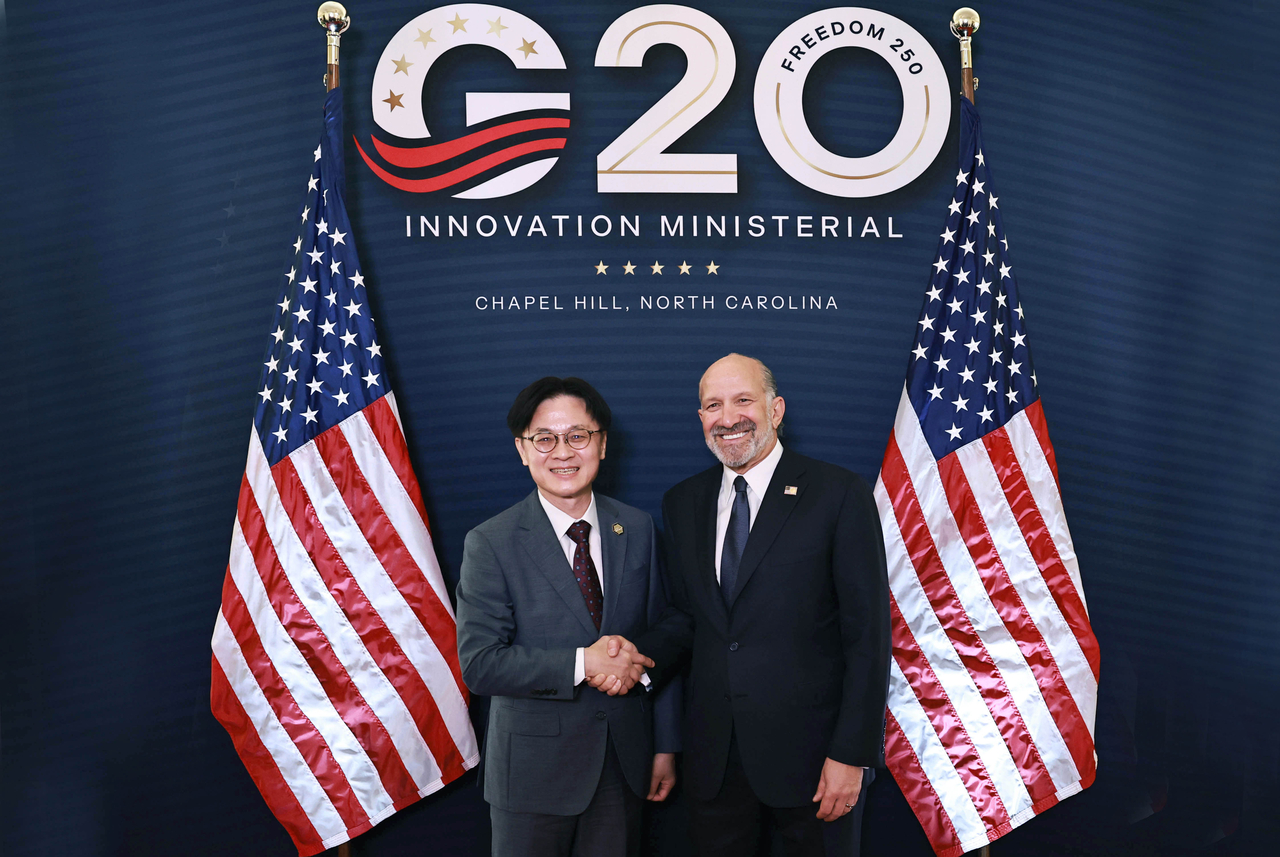
South Korea is moving closer to unveiling its first project under a major US investment program after Industry Minister Kim Jung-kwan returned Sunday from three days of talks in New York, with a closed-door briefing to lawmakers scheduled for Sept. 17.
Kim met US Commerce Secretary Howard Lutnick and other officials from Thursday through Saturday to discuss prospective projects, investment amounts and terms. He traveled to the US directly from Europe after accompanying President Lee Jae Myung on his state visit to France.
“I came to wrap up the ongoing US investment negotiations,” Kim told reporters upon arriving at Newark Liberty International Airport on Thursday, adding that talks should be considered ongoing until a final agreement is signed.
The Encinal combined-cycle gas power plant project in Texas and large-scale nuclear power projects have been cited as leading candidates. The Ministry of Trade, Industry and Resources, however, said no specific project has been finalized and consultations with Washington are still underway.
The ministry recently gave lawmakers a closed-door update on follow-up negotiations. A National Assembly official who received the briefing said the two projects were understood to be “nearly certain,” although the government has yet to announce a final decision.
Kim is expected to report the outcome of the latest talks to the National Assembly on Thursday, offering a clearer picture of the first project and the timetable for carrying out the investment package.
Korea committed to $350 billion in US investments during tariff negotiations with Washington last year, including $150 billion for shipbuilding cooperation and $200 billion for strategic investments.
Alongside the choice of projects, attention is turning to safeguards written into the memorandum of understanding governing the program.
Under the memorandum of understanding, only projects deemed commercially reasonable are to be recommended to the US president. That means a project should be expected to generate enough cash flow during the investment period to repay principal and interest.
An investment committee chaired by the US commerce secretary is to recommend projects after consultations with the Korean side, while US President Donald Trump has final authority over project selection.
Korea’s annual strategic investment is capped at $20 billion, and funds are to be transferred no earlier than 45 business days after Washington notifies Seoul of its selection.
The two sides also agreed to establish an umbrella special-purpose vehicle to oversee the program and manage risks across individual projects.
Recent reports, however, have suggested that profits and losses could be settled separately for each project, raising questions over how much risk can be shared across the broader structure. The government has not announced a final arrangement.
The Encinal project has also drawn attention following reports that Washington sought to raise its cost from around $20 billion, with the two sides said to be discussing a figure in the $22 billion range. Seoul has said no amount has been finalized.
Reports that roughly 3 trillion won ($2.2 billion) could be transferred to the US by the end of this month have also raised questions, as such a timeline would appear to conflict with the minimum 45-business-day waiting period. The government says no transfer schedule has been decided.
Another variable is the Alaska liquefied natural gas project, which has continued to surface in discussions despite questions over its commercial viability.
Kim’s parliamentary briefing this week is expected to show not only which projects move forward first, but also how the safeguards agreed by Seoul and Washington will operate as the investment program moves into implementation.
By Jie Ye-eun (yeeun@heraldcorp.com)