

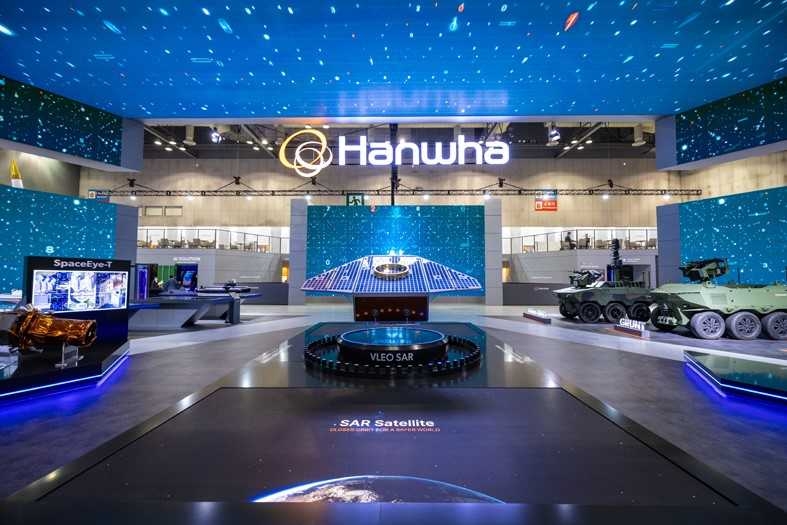
Hanwha Group is accelerating its push into the global space industry, expanding capabilities across satellite manufacturing, launch, ground operations and data services, as it seeks to position itself as a full-spectrum space solutions provider.
At the center of the effort is Hanwha Systems, which has been strengthening its synthetic aperture radar, or SAR, satellite technology following the successful launch of Korea’s first domestically developed small SAR satellite in December 2023.
Unlike optical satellites, SAR systems use microwave radar that can penetrate clouds and operate regardless of weather or time of day, enabling high-precision Earth observation and reconnaissance.
The company is currently developing next-generation small SAR satellites with higher resolution, including an ultrahigh-resolution model capable of identifying objects as small as 15 centimeters from space. The satellite is slated for launch within 2026.
Hanwha’s satellite push comes as Korea prepares to advance a multiministry-led project to deploy a constellation of around 40 SAR satellites aimed at strengthening surveillance capabilities over the Korean Peninsula and surrounding regions.
Beyond hardware, Hanwha is expanding into satellite data services by integrating artificial intelligence into its space platform. High-resolution imagery captured by its satellites is analyzed in near real time through the company’s AI systems, allowing rapid detection of anomalies and transmission of intelligence to command systems.
The company has also developed a mobile ground station equipped with AI-based satellite image analysis, designed to maintain operability and survivability in wartime environments where fixed communication infrastructure may be compromised.
This reflects a broader shift in the satellite industry toward “New Space,” where companies leverage commercial components, lightweight designs and multisatellite launches to reduce costs and scale deployment.
Hanwha’s small SAR satellites feature an integrated structure combining payload, body and solar panels, enabling more efficient use of launch capacity and lowering overall launch costs.
The company demonstrated its technological capabilities in April 2024 by releasing the first images captured by its satellite, including detailed views of New York’s Manhattan skyline and Dubai’s Palm Jumeirah, with image quality comparable to that of advanced global operators.
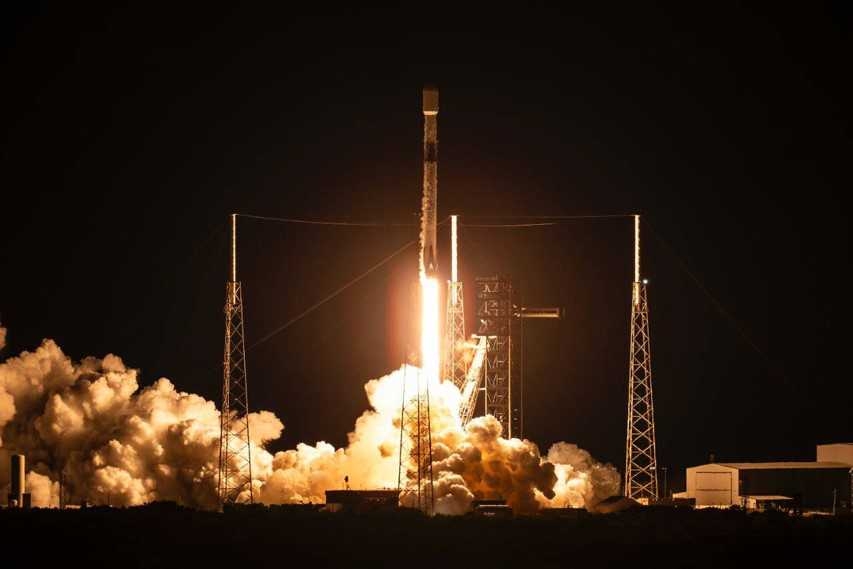
Hanwha has also played a key role in Korea’s military reconnaissance program, supplying SAR payloads for multiple satellites under the “425 Project,” a five-satellite system designed to enable independent surveillance capabilities. The successful deployment of the final satellite marked a milestone in Korea’s efforts to establish its own reconnaissance satellite network.
Looking ahead, the company is working to localize key satellite components — including antenna systems and feed arrays — that have traditionally relied on foreign technology, aiming to strengthen both national security and industrial competitiveness.
The global satellite market is projected to reach $615.7 billion by 2032, growing at an annual rate of 8.1 percent, according to Allied Market Research, underscoring rising demand for satellite-based services and data.
With capabilities spanning satellite production, AI analytics and downstream services, Hanwha is positioning itself to capture value across the entire space value chain, from infrastructure to applications.
By Jeon Ji-woo (jwjeon7625@heraldcorp.com)