
Backed by chip-driven dollar inflows and won's growing unpredictability, local currency defies traditional relationship with Korea's benchmark stock index
The Korean won is saying goodbye to the days when its fortunes were closely tied to the ups and downs of the local stock market.
Stock prices and the won's value have typically moved in tandem. Offshore investors hold roughly 40 percent of the main bourse Kospi's total market capitalization. When they sell shares and convert the proceeds into dollars for repatriation, rising dollar demand puts downward pressure on the won.
Conversely, when they convert dollars into won to buy Korean shares, demand for the local currency increases, supporting the won against the greenback.
Recently, however, that long-standing link has begun to weaken.
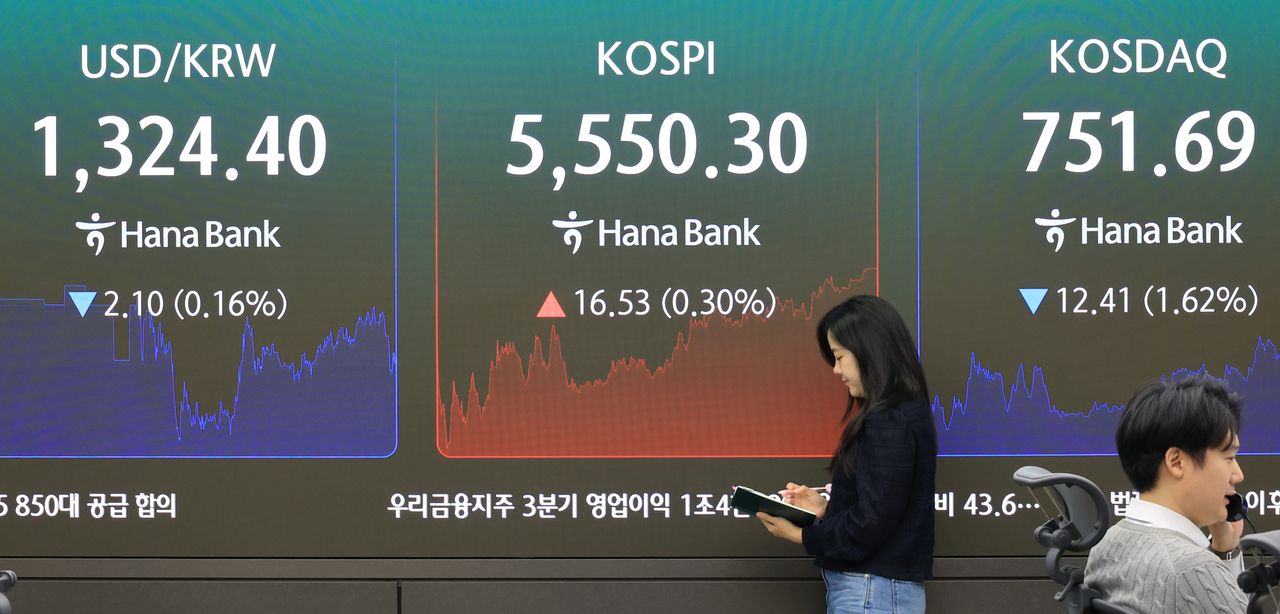
The won depreciated to 1,549.4 per dollar on June 30, its weakest level since the global financial crisis, but has since rebounded sharply: The currency strengthened to 1,324.2 per dollar on Thursday, reaching its strongest level in two years in under four months.
Over the same period, foreign investors sold a net 62.84 trillion won ($47.4 billion) worth of shares on the main Kospi market, sending the index tumbling 34.5 percent from 8,476.48 to 5,533.77.
The divergence comes as record semiconductor trade surpluses drive dollar inflows, while the won's increasingly unpredictable movements add to uncertainty in the foreign exchange market.
Dollar glut from chip exports
The semiconductor export boom is flooding the domestic forex market with dollars, creating a supply-demand imbalance.
Fueled by strong chip shipments, the country's exports surpassed $121.1 billion in September, bringing the cumulative total to $814.7 billion. The figure had already surpassed last year's full-year record of $709.3 billion, with the fourth quarter still to come.
The record-breaking export boom, coupled with the government's earlier push for companies to convert their dollar holdings into won, has boosted dollar supply in the forex market, even offsetting outflows from foreign investors.
"Exporters' dollar-selling flows are likely to remain a dominant force in the forex market in the near term," Min Kyung-won, an economist at Woori Bank, said.
"Expectations of increased dollar supply are also likely to encourage short-selling, particularly among offshore players, adding further pressure on the won-dollar exchange rate."
A new playbook for won
The won's increasingly unpredictable nature is also contributing to its decoupling from the stock market. In recent years, the currency has become prone to sharp, sometimes abrupt swings in both directions.
While a sustained appreciation of the won would normally encourage foreign investors to buy Korean stocks in anticipation of currency gains, some argue that the won's recent strength is having the opposite effect, prompting them to sell in fears of a sharp reversal in the currency's direction.
"From the second half of last year through the first half of this year, the Kospi rallied as the won weakened. But since the won began to strengthen, the index has plunged," said Park Sang-hyun, an analyst at iM Securities, describing the trend as "rare."
"The won's rapid appreciation and heightened currency volatility are fueling foreign investors' selling sentiment toward Korean equities."
Park pointed to the won's lopsided appreciation against the yen as another sign that the currency is deviating from its usual trajectory.
On Tuesday, the won strengthened to the 830 level per 100 Japanese yen, its strongest since January 2008. Given that the won is often considered a proxy for the yen, the won's one-sided appreciation against the safe-haven asset signals the won is moving out of sync with its traditional drivers.
"Looking at the won-yen exchange rate, the local currency's latest appreciation is gradually approaching excessive levels," Park said.
By Im Eun-byel (silverstar@heraldcorp.com)