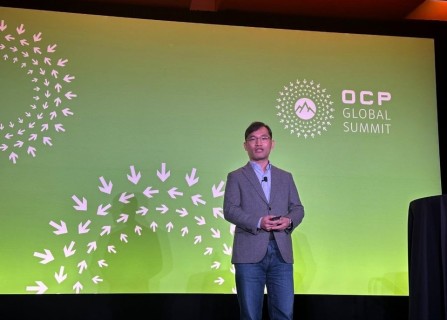

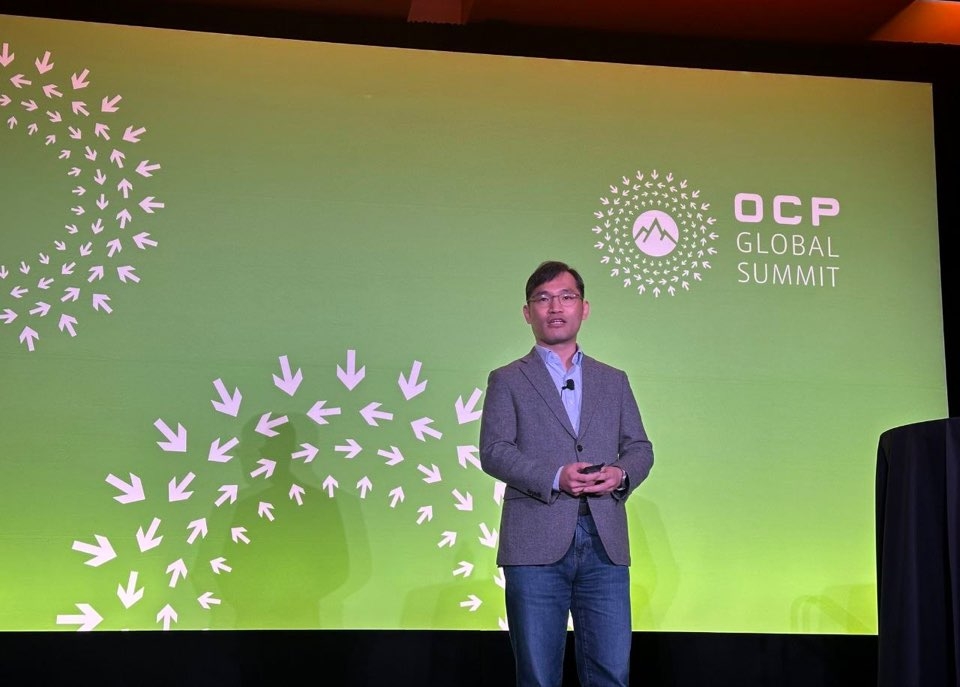
Samsung Electronics outlined plans to improve AI data center performance through faster memory, expanded capacity and more efficient storage at the Open Compute Project Global Summit 2026 in San Jose, California, the company said Tuesday.
The Korean chipmaker showcased its latest high-bandwidth memory, including eighth-generation HBM5, custom HBM solutions, and processing-in-memory technology designed to accelerate data processing and improve power efficiency.
Samsung also highlighted Compute Express Link (CXL) memory expansion technology and advanced solid-state drives.
As AI models grow larger and inference workloads become more complex, memory capacity and storage efficiency are becoming as critical as processing speed. In particular, AI systems increasingly rely on key-value (KV) caches, which store previously computed data to reduce repetitive processing.
Shim Ho-jun, a corporate vice president leading Samsung's application engineering team, said the company is focusing on three priorities: speed, memory expansion and data persistence.
Samsung said its CXL-based CMM-D modules can expand server memory capacity and allow multiple systems to share pooled memory resources. High-capacity quad-level-cell flash and flexible data placement technologies to improve storage efficiency are also in development.
In a joint demonstration with Advanced Micro Devices, Samsung showcased a CXL-based memory pooling solution designed to help AI systems manage growing memory demands, particularly as AI agents become more widely deployed.
The company also displayed HBM4E and HBM5, custom HBM concepts, LPDDR5X processing-in-memory technology, 2-nanometer gate-all-around wafers, and Groq language-processing-unit wafers. Other exhibits featured enterprise SSDs, KV-cache optimization, vector databases and liquid-cooling solutions.
Samsung is seeking a larger role in AI system design by working more closely with customers and technology partners. Its MAX Lab lets customers test precommercial memory and storage products under realistic AI workloads, allowing system requirements to be reflected earlier in development.
Samsung's Global Open-ecoSystem Team is also participating in open-source software development and industry standardization.
By Jo He-rim (herim@heraldcorp.com)